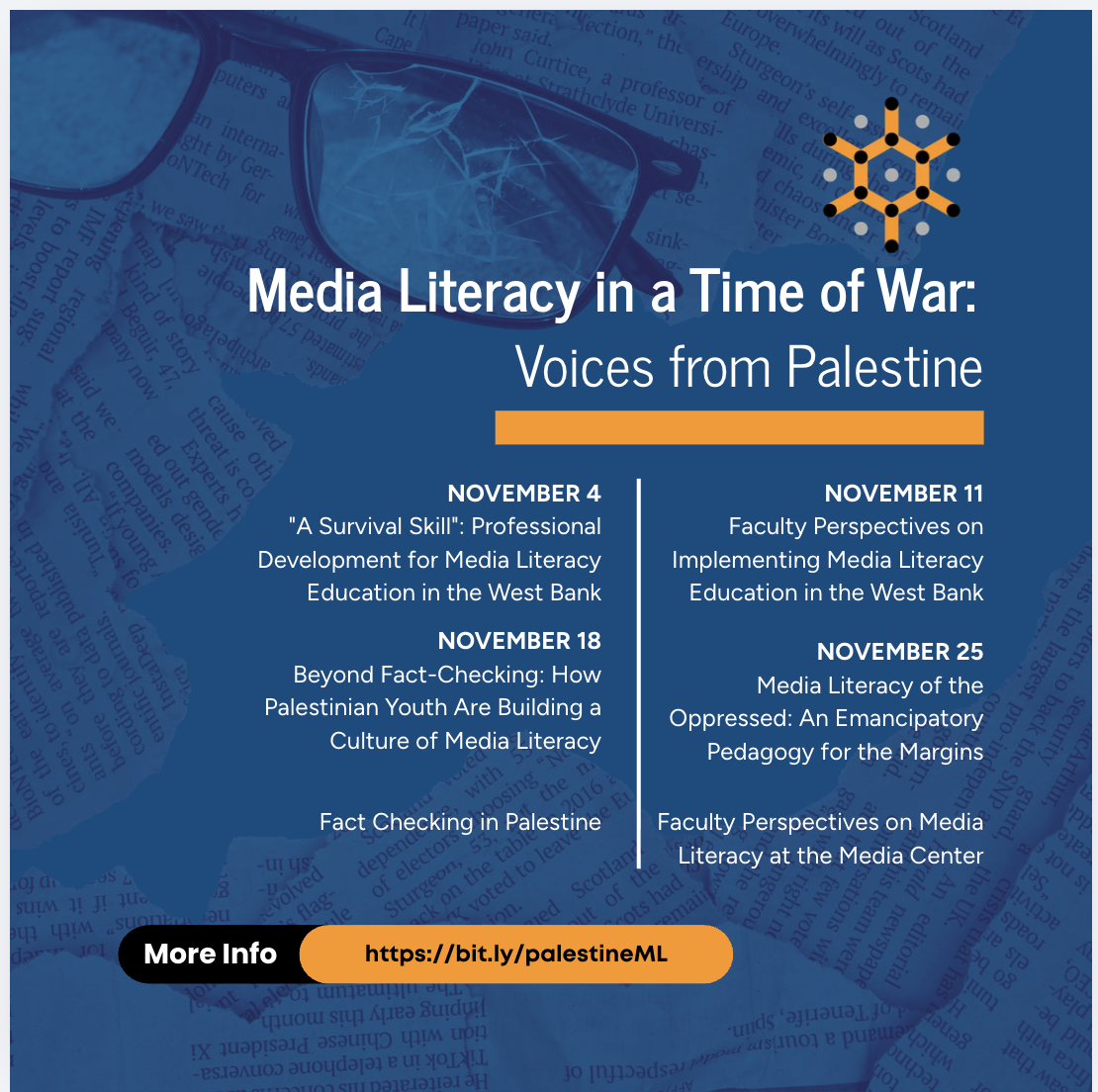
 Media Literacy in a Time of War: Voices from Palestine
For young people in the West Bank, questioning a viral image isn't a classroom exercise. It's a matter of safety. This free six-part webinar series brings educators, researchers, students and activists from around the world together with the Palestinian faculty and youth who have been building media literacy under occupation, war and displacement.
"A Survival Skill": Professional Development for Media Literacy Education in the West Bank
DATE: Wednesday, November 4, 2026
TIME: 11 AM EST | 6 PM Jerusalem time
LOCATION: Online. Click here to register
Presenters: Renee Hobbs, Bilal Younis, Yonty Friesem
Respondent: Inad Nawajah
For young Palestinians, questioning a viral image isn't a classroom exercise—it's a matter of safety. This opening session presents findings from Media Literacy: Critical Thinking for an AI World, a 21-month program that trained 17 Palestinian educators, reached 138 youth, and drew 4.9 million views on Instagram for youth-created media work. Learn what the data revealed about teaching media literacy competencies amid propaganda, deepfakes, and "conflict entrepreneurs" who profit from polarization and why educators described media literacy as civic survival.
ABOUT THE PROGRAM SERIES
Across six one-hour Wednesday sessions beginning November 4 (6–7 PM Jerusalem time), you'll hear findings from Media Literacy: Critical Thinking for an AI World, a 21-month program that reached 138 young people and drew 4.9 million Instagram views for youth-created media. Palestinian faculty will share the teaching frameworks they wrote in pairs, from a "Stop, Think, Verify" golden rule to lessons built on the claims their students were already arguing about online. The youth-led organization Media Compass will show how students are going beyond fact-checking to explore algorithms, AI and critical thinking, and are becoming educators themselves.
The series also looks beyond the West Bank. Jad Melki of the Lebanese American University, author of Media Literacy of the Oppressed, sets out an emancipatory pedagogy rooted in local priorities and postcolonial history. Palestinian fact-checkers explain how they verify information when the story is their own and the pace of disinformation never slows. The final session showcases the An-Najah National University Media Center, a comprehensive broadcast, training, and digital production hub located in Nablus. where faculty and students produce and analyze media in a place that is constantly misrepresented.
Whether you teach in a university, a secondary school or a community program, this series offers practical strategies, hard-won insight and a new understanding of why many Palestinian educators call media literacy a survival skill. Join the conversation and bring a colleague. This webinar series is free and all are welcome to attend.