Review | MediaEd Insights | Back to School: Reflections on Teacher Education Edition | September 2026
Written by Michele Johnsen, Monika Hanley, and Catherine Morris
Origins of the Institute (Written by Monika Hanley)
.jpg) The University of Washington Media Literacy Institute grew out of an idea that emerged in 2021. Media literacy educator Frank Baker had participated in teacher-librarian training in another state and those in the field saw the potential for bringing a similar opportunity to Washington. With heavy lifting from Dr. Marilyn Cohen of the UW Dept. of Education managing much of the work behind the scenes to establish and coordinate the program, the inaugural Institute covered a broad range of media literacy topics, including issues surrounding violence, social media, social justice, disinformation, film, and brought in additional educators and experts to explore different dimensions of the field.
The University of Washington Media Literacy Institute grew out of an idea that emerged in 2021. Media literacy educator Frank Baker had participated in teacher-librarian training in another state and those in the field saw the potential for bringing a similar opportunity to Washington. With heavy lifting from Dr. Marilyn Cohen of the UW Dept. of Education managing much of the work behind the scenes to establish and coordinate the program, the inaugural Institute covered a broad range of media literacy topics, including issues surrounding violence, social media, social justice, disinformation, film, and brought in additional educators and experts to explore different dimensions of the field.
The response showed that there was a strong appetite for this kind of professional learning. However, while the original vision was to offer participants university credit for an intensive media literacy program, it became clear that most educators were not looking for academic credit. What they needed—and wanted—were professional learning opportunities and clock hours that they could apply toward their continuing education requirements. The Institute then evolved from a full-quarter course in its first year into a concentrated, week-long summer institute.
UW saw the potential to continue and develop the program, and Tessa Jolls, President of the Center for Media Literacy (CML), became involved in leading its evolution for the next year together with Monika Hanley and Michele Johnsen, CML associates. Under a new week-long intensive model, the Institute increasingly centered on empowerment: educators should leave not simply having learned about media literacy, but equipped to take what they learned back into their own classrooms and communities. The emphasis shifted toward evidence-based pedagogy and practical approaches that educators could adapt across subjects, grade levels, and educational settings.
Much like the information environment itself, the Institute has also evolved. In 2022, there were exercises with identifying narratives in physical newspapers, while 2026 involved much more AI use, ethics, integration, and analysis, as well as algorithmic systems.
Over the Years (Written by Michele Johnsen)
When Monika and Michele first joined Center for Media Literacy President Tessa Jolls as faculty for the Media Literacy Institute at the University of Washington in the summer of 2022, educators were navigating the challenges of online teaching during a global pandemic, while also confronting the growing risks of health-related disinformation on social media.
True to the Institute’s promise to give participants what they need most in the moment, we focused on providing educators with practical media literacy tools and activities that could be easily adapted to an online classroom. Monika and Michele learned the ropes from Tessa as she deftly introduced participants to the Five Key Questions and Core Concepts, two foundational elements that remain cornerstones of the Institute today.
By the summer of 2023, Monika, Michele, and Tessa were sharing the teaching responsibilities equally. Together, they streamlined the Institute’s agenda, creating more time to explore the critical thinking concepts at the heart of media literacy. Examples and activities involving the internet and social media became an even greater part of the Institute, helping educators meet their students where they were.
At that time, the faculty were beginning to hear the first “whispers” from participants about artificial intelligence and the risks and opportunities it might present. Deepfakes were mentioned, but they were not yet top-of-mind for most Institute participants. By the summer of 2022, however, those whispers were growing louder. ChatGPT would launch later that year, in November, and the media landscape was about to change dramatically.
The 2023 Media Literacy Institute was the first time that participants came with a sustained and active concern about AI and its impact on teaching and learning. “How do I know if my students are using AI?” “What do I do about it?” “Is my district going to adopt it?”
Media literacy alone could not answer all of these questions, but it offered an exceptional foundation for helping educators and students to think critically about how AI is created, used, shared, and understood. By then, Monika and Michele were teaching the majority of the Institute. They delved more deeply into how educators and students were and were not using AI, and adapted the Institute’s agenda to include more activities, discussion, and reflection around teaching and learning in an AI-powered world.
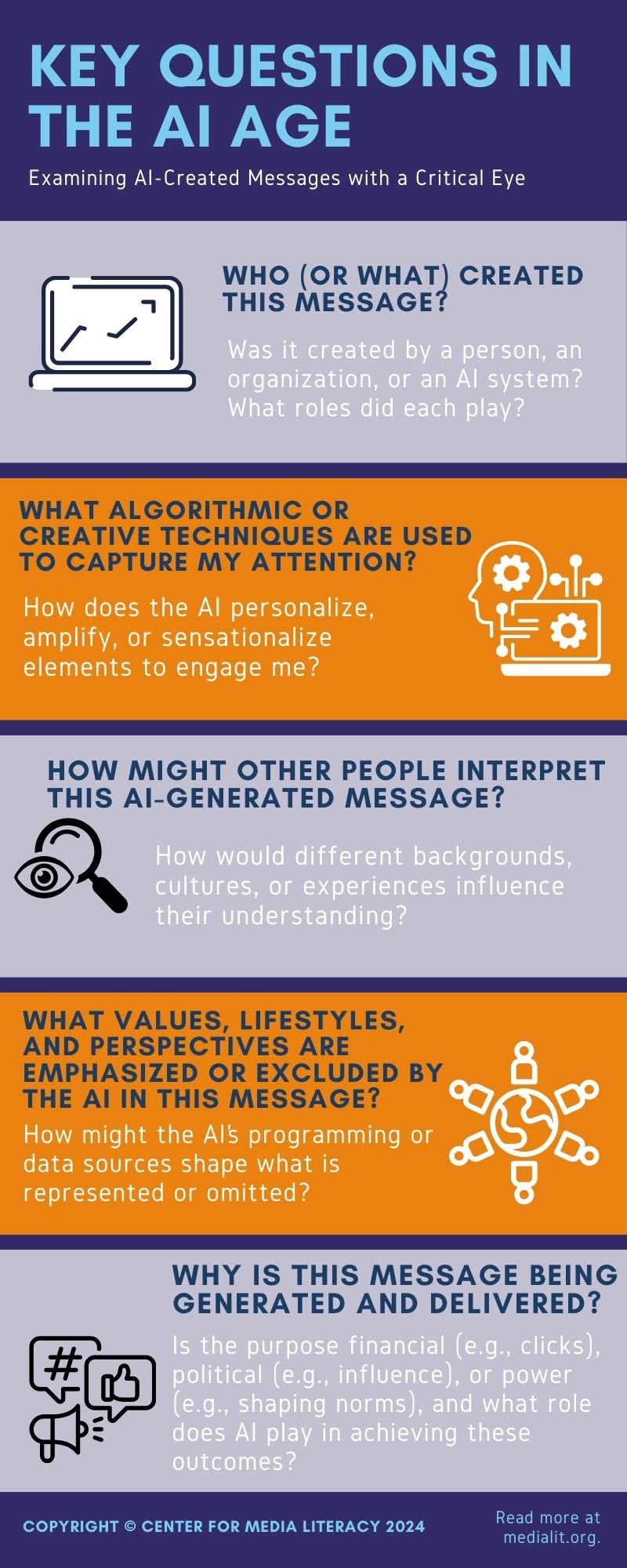
In 2024, they introduced Institute participants to the newly created Five Key Questions and Core Concepts for the Age of AI. This framework gave educators a direct way to apply foundational media literacy questions when encountering AI-generated content and considering the ethical questions surrounding AI. The Institute’s reach also expanded beyond educators, welcoming participants from organizations including the Girl Scouts and a youth health advocacy group.
Sadly, Tessa Jolls passed away in March 2025. Monika and Michele became fellows at the Media Education Lab and continued the Institute, ensuring that Tessa’s vision of responsive, relevant media literacy education carried forward. The Lab became a sponsor of the Institute, and Executive Director Yonty Friesem helped identify expert speakers on AI in education, adding new perspectives and expertise to the program.
Participants were encouraged to incorporate AI into the media literacy activities and lesson plans they developed to take back to their classrooms. The Institute also created additional opportunities for participants to reflect on what it means to practice and teach media literacy in an age of AI.
This summer, Media Education Lab Assistant Director Catherine Morris (and Institute alumnus) joined the faculty, bringing a fresh perspective, enthusiasm, and additional expertise in both media literacy and AI. She also gave participants a sneak peek at Pause2MAP, the Media Education Lab’s interdisciplinary digital wellness and media literacy framework.
2026: From Participant to Facilitator (Written by Catherine Morris)
In 2025, I attended the Media Literacy Institute put on by the University of Washington, hosted by Monika Hanley and Michele Johnson. As someone who was not a classroom educator at the time, the reason I attended was the developing partnership between what had been the Center for Media Literacy and the Media Education Lab. Further, as someone whose media literacy origin story began with Renee Hobbs during my undergraduate studies at the University of Rhode Island, this was really my first foray into a media literacy-centric space that was not entirely originated by the Media Education Lab. Having a deep knowledge of and involvement with media literacy, but only through one lane of the field, made for a compelling and expansive experience.
As I look back on my notes from that experience, I notice my enthusiasm for new ideas I encountered. A new concept for me, for example, was adding repetition to guided viewing—specifically, viewing a piece of media multiple times, each time with a different sense removed or a different focus. A second “aha moment”, for me, was the framing of perspective and bias as narratives. Using less loaded language can be a powerful tool for making sure that learners are not shutting down or getting defensive before they have had an opportunity to engage with the intended lesson. There were many moments like these throughout the Institute: ideas that were familiar enough to connect to my existing understanding of media literacy, but different enough in their framing or application to expand it.
I also noticed areas where greater collaboration and integration with the Media Education Lab’s approaches, stylistic choices, and emerging best practices could strengthen the Institute. Those observations did not feel like criticisms so much as invitations to conversation. What might happen if we brought these different perspectives into closer dialogue? Which practices could be shared across organizations and contexts? And how might the Institute continue to evolve while maintaining the elements that have made it valuable to participants over the years? Those conversations ultimately led to something I did not anticipate when I arrived as a participant: returning the following year as a member of the faculty.
The transition from participant to facilitator gave me a very different perspective on the Institute. Having experienced the Institute as a learner, it felt natural to think more deliberately about how those ideas were introduced, how participants might interpret them, and how the individual pieces of the Institute fit together as a larger learning experience. I was reminded once again how much intentionality goes into creating a space that can serve participants with different professional backgrounds, levels of experience, and reasons for attending.
That shift also reinforced something of which Monika, Michele, and I are keenly aware: media literacy is both a well-established field and one that is continually being redefined by changes in the media environment. The foundational questions remain remarkably durable, but the examples, technologies, concerns, and contexts through which we explore them are constantly changing. As facilitators, we have to apply that theory to our own teaching. The Institute has to provide enough structure that participants leave with a shared foundation, while remaining responsive enough to address the questions and challenges that participants bring with them.
We modeled that principle by reflecting upon past Institute experiences, which is one of the many ways that my experience as a participant contributed to my new role as co-facilitator. We offered a few new topics, like how we relate to artificial intelligence as human beings and the necessity for community for true media literacy. Returning in 2026 also gave me an opportunity to contribute to the Institute as a bridge between communities of practice that had previously informed my own understanding of media literacy. This year, we adapted our facilitation style to include some practices developed and refined by the Media Education Lab, like pausing after instruction to invite inquiry, dialogue, and discussion, in the spirit of the “everyone learns from everyone” principle.
I was able to bring ideas and approaches from my work with the Media Education Lab while learning from Monika, Michele, and the Institute participants themselves. That exchange was particularly valuable because the Institute has never been simply about presenting a fixed body of knowledge. Its strength is in creating opportunities for educators and other professionals to test ideas, question assumptions, share experiences, and consider how media literacy can be applied to the environments in which they work.
Perhaps the most meaningful part of moving from participant to facilitator was realizing that the Institute’s evolution is not something that happens only between years. It happens within each Institute, through the questions participants ask, the examples they share, the activities they respond to, and the conversations that continue after a session ends. My experience across two years made that process especially visible to me. I arrived in 2025 ready to learn from the Institute; I returned in 2026 with the opportunity to help shape the experience for others. In both roles, I came away with a deeper appreciation for the value of creating spaces where media literacy practitioners can learn from one another, and where the field itself can continue to learn and change.
Moving Forward (Written by Michele Johnsen)
And so, once again, a team of three, Monika, Michele, and Catherine are looking ahead to the 2027 Media Literacy Institute through the University of Washington. They are already “scheming” about ways to bring the Institute to new geographic locations and to additional groups who share their passion for giving young people the tools they need to become critical thinkers. Because if the past six years have taught us anything, it is that the media environment will continue to change. Our goal is to make sure educators and their students have the critical thinking tools they need to change with it.
MediaEd Insights | Back to School: Reflections on Teacher Education Edition | September 2026
Opening Essay: Courage Is Learned Together: Why Professional Development Is the Heart of Media Literacy Education by Yonty Friesem
Review: Collaborative, Responsive, and Future-Focused: Reflections on the Media Literacy Institute by Michele Johnsen, Monika Hanley, and Catherine Morris
Case Study: By Students, For Students: Building Community at the MediaEd Graduate Symposium by Allie Thrall and Salome Apkhazishvili
Research Brief: What's Going on with Media Literacy in Massachusetts: A Landscape Scan by Media Literacy Now and the Media Education Lab
Comments(0)